
As a member of the Church of Jesus Christ of Latter-day Saints, members of the ward (a congregation based on geographical boundaries) are often assigned/asked to give “talks” (which is just a lower-stakes way of calling it a sermon) in sacrament meeting. Some of the talks I’ve given in my adult life can be found here.
The Importance of Gospel Study and Learning in the Home
When I was in the 4th grade, my dad took a job with the PGA TOUR here in Jacksonville, and our family moved from Bountiful, Utah in February. We moved in to the Mandarin 1st Ward, where my parents still reside and my mom is a nursery leader and my dad is the Primary Chorister. In the 1st Ward also reside Wayne and Michelle Reading, who have 5 boys who were all fairly close to my age.
One of my earliest memories of Jacksonville was when my dad and I went over to someone’s house to help out with something. Wayne was also there, and at the time, he drove a small sedan that was quite literally held together with duct tape. When I say that this car was falling apart, that is an insult to jalopies.
I mentioned this to my dad – how come Wayne doesn’t buy a new car? Surely he can afford it?
My dad then said something that I have never forgotten: “That’s the kind of man Wayne is. He’d rather go without so that his family and children can have more, and sometimes that means not getting a new car even though you might really need one.”
Wayne later served as my young men’s leader, bishop, and has been a trusted leader and mentor throughout my life, and has exemplified the concept explained to me by my dad all those years ago.
If you were to go into any classroom in the world at any given time, you would more than likely find a teacher explaining a concept in multiple ways. This explanation might happen via the teacher working out a sample problem on the whiteboard, walking students through its steps. It might be an instance where the teacher is acting out an example of the issue, or explaining an old concept in new slang and terms. Whenever teaching is happening, my experience is that learning through doing and example are the best methods. It is no coincidence that the Savior did almost all of his teaching by example and through parables. How better to explain complicated concepts than by using the everyday experiences that all of us have? Take, for example, his invitation to Peter and the other apostles – come, follow me, and I will make you fishers of men. It is no coincidence that the Savior used this language to reach out to Peter and the other apostles, as that was the language they would understand. The Savior taught in common areas, in houses, the street, and other public concourses. How can we apply this same model to our lives?
In 1 Nephi 19:23, we read, “for I did liken all scriptures unto us, that it might be for our profit and learning.” Nephi taught his siblings using the scriptures of his time – not the first five books of the Old Testament, but the contemporary teachings of the prophet Isaiah. I would contend that we often look at gospel learning in too narrow a fashion. Almost any situation where the Spirit can testify of truth is a learning experience. This could be in a classroom at school, at work, on the road, in a discussion between friends, reading a book or watching a movie, or a multitude of other places. The critical aspect is to learn something and change our behavior because of it.
One of my favorite stories in the scriptures is that of the woman taken in the act of adultery. This woman, presumably a known member of her community, is accosted in the very act of transgression and brought to the temple to receive judgment. Her accusers, men of standing in the community, ask the Savior, a noted teacher and scholar of the Mosaic Law, if they should stone her as is the traditional punishment. The Savior does something that I have always found curious. He stoops down, and starts to write or draw in the dirt. He does not immediately answer the accusers nor does he immediately address the accused. He simply kneels down and seems to ignore them all. Then, after a time, he stands and utters the statement, “He that is without sin among you, let him first cast a stone at her.” Shortly thereafter, the oldest down to the youngest of her accusers depart, being “convicted by their own conscience” until it is simply the Savior and the woman left standing alone. He then addresses the woman, asking “where are those thine accusers?” and then telling her “Neither do I condemn thee. Go, and sin no more.”
He does not forgive her immediately; nor does he condone what she did; but Jesus extends mercy to someone who most surely could use it, and taught those who were so quick to judge something about the nature of justice and mercy.
Growing up, I spent a lot of time in this specific ward building. There are aspects to it that I know about more than most, and I am painfully aware of the missing lights, or the specific function (or lack thereof) of various parts of the meetinghouse. Having attended many ward parties and other functions in this building, I was also party to much of the cleanup and setting up of chairs for the next day’s Sunday services. One such experience stands out clearly in my mind. I wasn’t any older than 12 or 13, and I was walking with a trash bag in hand from near the Bishop’s office. As I was walking to take this trash out to the dumpster, I came across the path of my young men’s advisor, Aaron Hamilton. He was walking the halls, picking up small pieces of trash or detritus that hadn’t been picked up by the vacuum.
Was that really needed? Probably not. But it stuck out in my mind – a man I very much admired, on his hands and knees, doing his best to keep the chapel where he and his family worshiped clean and respectable. I learned something then about the importance of service, no matter how big or small.
When I was 14, my dad was called as the bishop of the Mandarin 1st Ward. This often meant he stayed after church for long periods of time. At this time, the bishop of the ward wanted the young men to go out and collect fast offerings individually. This was before the advent of digital tithing and honestly before smartphones were very common. The young men were usually driven/escorted by their dads on these routes, which posed a problem for me because I could not drive and my dad was busy with other aspects of his calling. In stepped Ken Lovell. Ken offered to take me and my brother on our fast offering routes, which was about an hour or 2 that he spent with us in his car, using his gas, to fulfill our priesthood duty. Never once did Ken complain, even when my brother almost drove his very nice car into a mailbox. Ken taught me the values of patience, of education, of honoring your priesthood, and being kind while never once preaching or lecturing. The casual conversations had in the car on those Sundays shaped my view of the world and how I try to serve those around me.
In light of all these experiences, there were no greater lessons than those I learned in the home from my parents. While my experiences with mentors, leaders, and respected adults definitely filled in gaps and shored up weak areas of my testimony, learning the gospel started in the home with my mom and dad. Ever since 2005, for example, my dad has held the following callings: bishopric counselor, bishop, high councilor, stake presidency member, high councilor and now, he is the Primary chorister. I can guarantee you that of all the callings he has had, that is by far his favorite calling. Why? Some might think that going from a leadership position and serving as a leader in a ward or stake for so long and then being called as a Primary chorister would almost feel like a demotion. But something I learned in the home from both my parents was this eternal principle: it matters not where you serve, but how. It does not matter whether you work toward hastening the salvation of an entire stake, or you are seeing the same 4 Primary kids every week – it simply matters that you are serving to the best of your abilities. We are not judged on how many “important” callings we have held, but on how we have tried to emulate the Savior when serving others in our callings.
Take, for example, my mother. My mom was raised in a semi-active household and had a fairly difficult upbringing. She and her younger siblings were eventually taken in and raised by her grandparents, who quite literally saved their lives. My mom had very patient young women’s leaders, and eventually served side-by-side with other women in Primary who taught her many lessons. It is no coincidence to me that my mother has almost exclusively served in the Primary during her entire church service. She has been a primary teacher, primary president, primary presidency member, stake primary president, stake primary presidency member, and nursery leader. She has, by my estimation, taught hundreds of children the gospel, the importance of the Atonement, and how to follow the Savior. Never once has this been done via lecture.
Some other lessons I learned in the home: the importance of peace and quiet and being able to hear the still, small voice of the Spirit; the value of studying the scriptures and teachings of prophets and apostles; that there is humor and joy to be found in life; the importance of reverence and treating sacred things as such; and so much more.
Ultimately, as a fairly new parent, I am still learning and growing, and as a person I am still learning and growing. I am thankful to those around me who have taught me, those who have called me out on my nonsense, whether what I did was intentional or not, and my Savior, through whose grace I can become better. As a lifelong learner, I hope that I never stop learning, and that I can continue to grow in knowledge and spiritual stature so that I might better serve and minister to those around me. Of these things I testify, in the name of . . .
The Enabling Power of the Atonement
When I was 14, one of my family’s pet guinea pigs died. Her name was Tweety Bird, and while she was very sweet, she was incredibly skittish and probably died of a heart attack after hearing someone close a door too loudly. Pets were never a huge thing in my life growing up, so I was a little confused when, while burying Tweety Bird in the backyard, my mom was sobbing over the tiny grave.
At the time, I was struggling a lot. I had very few friends in high school and was incredibly lonely. School itself wasn’t too difficult, but the social vagaries of my teenage years were difficult for me to navigate. We had also received news that day that the eldest son of one of our close family friends, a young man named Matthew Buhler, had died by suicide.
I remember watching my mom weep on her hands and knees and asking my dad, “Why is mom crying so hard? I mean, I know it’s sad but it’s just a guinea pig.”
My dad then said something that has stuck with me ever since. He said, “Some of those tears are for Tweety Bird. But a lot of those tears are for Matthew and his family, and most of them are for you.”
He didn’t say that to make me feel guilty or anything of the sort. He simply said that because it was the truth. My mom felt sorrow for her dear friends and their family, and she had felt the pain and sadness I was struggling with.
In Mosiah chapter 18, we read “as ye are desirous to come into the fold of God, and to be called his people, and are willing to bear one another’s burdens, that they may be light; Yea, and are willing to mourn with those that mourn; yea, and comfort those that stand in need of comfort, and to stand as witnesses of God at all times and in all things, and in all places that ye may be in, even until death, that ye may be redeemed of God, and be numbered with those of the first resurrection, that ye may have eternal life. . .”
The Savior, in his earthly ministry, lived a life replete with examples of kindness and compassion. The Savior also had expectations for his followers and those whom he dealt with, and did not condone sin or transgression. He did, however, treat them with grace, and understood that the difficulties of mortal life are not easily traversed. I would like to speak on a few of these examples, and also how we might use them as examples to improve our own behavior and actions.
One of my favorite stories in the Bible is the Savior raising the son of the widow of Nain from the dead. In Luke chapter 7 we read,
“11 And it came to pass the day after, that he went into a city called Nain; and many of his disciples went with him, and much people.
12 Now when he came nigh to the gate of the city, behold, there was a dead man carried out, the only son of his mother, and she was a widow: and much people of the city was with her.
13 And when the Lord saw her, he had compassion on her, and said unto her, Weep not.
14 And he came and touched the bier: and they that bare him stood still. And he said, Young man, I say unto thee, Arise.
15 And he that was dead sat up, and began to speak. And he delivered him to his mother.”
There are two things that I especially love about this story. One, the Savior saw her, her being the widow, and he had compassion on her. He told her not to weep. He then, in a very tender moment, approaches the funeral procession, stops the pallbearers, and commands the young man to arise.
I think that in that moment, the exact nature of the Savior and his purpose on Earth was clear to the widow and son. Obviously we do not have all of the details of this interaction, but I would assume that the veil between this life and the next was very thin, and the Spirit was very strong. But this moment would not have been possible without two things: the death of the son and the subsequent grief of the mother, and the compassion shown unto them by the Savior.
But this is truly a miraculous event. How does it have any bearing on our lives today? While we are in the trenches of day-to-day existence, worrying about work, projects around the house, making sure our families are taken care of, fulfilling our callings, and so on – how do we apply the lessons learned? Well, I have a few ideas.
For one, we can never be too busy to show compassion and understanding to others.
The Savior was busy and had places to be, but he always had time to be kind and caring. In the middle of being pressed on all sides by people, he asked, “Who touched me?” and immediately was able to identify the woman who had an issue of blood. When Peter sliced off the ear of a guard that had come to arrest Jesus, the Savior immediately healed the injury. When the man stricken of the palsy was lowered down into the house where the Savior was teaching, he immediately blessed the man, forgave him of his sins, and told him to take up his bed and walk.
These examples show us that despite all that He had going on, the Savior made time for the individual needs of those around him. For us, maybe that looks like exercising a little more patience with the driver who cut you off or merged late. Maybe it is taking the time to be present and listening to our children and spouses. Maybe it is looking at how we treat others and choosing not to be angry and upset when we perhaps might be justified in doing so, and instead reacting with patience, grace, and love.
However, to be clear, the Savior never condoned sin or bad behavior. For example, when the woman caught in adultery was brought before him, her accusers demanded that, because of the law, she should be put to death by stoning. However, the Savior prevented that – he told those among her accusers that was without sin to cast the first stone, until they all disappeared. But he did not say that it was okay, or that she should go back to what she was doing previously.
No, he said,
“Woman, where are those thine accusers? hath no man condemned thee?
She said, No man, Lord. And Jesus said unto her, Neither do I condemn thee: go, and sin no more.”
The Savior gave the woman another chance, and, perhaps a different perspective on how she might use that chance. The Savior offers his grace to all, no matter their station in life, no matter their sins or transgressions or difficulties. The enabling power of the Atonement is available to all, and we simply have to access it in order to become better.
Just because this person sinned and needed compassion did not mean that the Savior had to change the law to satisfy them. Our sin does not exclude us from accessing the Atonement, but our sin does require repentance in order for us to truly be like Him. Sometimes, the consequences of transgression or sin are out of our hands. Sometimes, because of the actions of others, we are mistreated or there is a consequence that we cannot control. The Savior is not blind to these actions. Those who break commandments and laws will be held accountable before the judgment seat. This is the heart of the Atonement – Jesus Christ died for our sins so that we don’t have to be punished for them, so long as we repent and turn to Christ. He fulfilled the demands of justice, and we are treated with mercy. However, if one does not repent, they are held accountable for their actions.
As we read in The Family: A Proclamation to the World, “Husbands and wives—mothers and fathers—will be held accountable before God for the discharge of these obligations.” Those obligations being “providing for physical and spiritual needs, loving and serving, and observing the commandments of God.”
In the 2nd book of Nephi, we read, “For we labor diligently to write, to persuade our children, and also our brethren, to believe in Christ, and to be reconciled to God; for we know that it is by grace that we are saved, after all we can do.”
This verse can be read two ways, and I think the way we often read it mistakenly makes us think we need to earn the grace of Christ. The phrase that we get hung up on is ‘after all we can do’. In this context, it seems like we are saved by grace after we do a certain amount (all) that we can. But that’s not the case – grace is available to us no matter where we are. A gift wouldn’t be much of a gift if we had to pay 10 million dollars just to use it. Consider reading it the following way.
“We know that it is by grace that we are saved, despite all we can do.”
We are not asked to earn the grace of God. It is simply there. Christ died on the cross and performed the Atonement so that all might access the saving and enabling power thereof. He broke the bands of death so that all might be resurrected, not just those with the most chairs carried in their arms while setting up stake conference.
However, the Savior does ask us to do something – something that can fall by the wayside. He asks us to be changed by his grace. He asks us to put off the natural man and to become more like him, to work on aligning our will with the Father’s will. Grace isn’t just about being saved. It’s about becoming like our Savior, so that we might be like him and have experiences like his with the widow of Nain; with the family and daughter of Jairus; with Mary and Martha and Lazarus; with those he loved and knew. The ultimate beauty of the Atonement, Crucifixion, and Resurrection isn’t that we get to live forever. No, it is that we can become perfected, complete people, who have made mistakes, grown to be better people because of the lessons learned from those mistakes, and that we can live in peace and harmony with our God and our families for eternity. It is my testimony that the Atonement can heal and change us, that we can become like the Savior because of his sacrifice, and my prayer that we access the grace and enabling power of the Atonement, in the name of…
The Blessings of Tithing and Tithing Settlement
When the church of Jesus Christ was restored in 1830, most people probably did not foresee how it would become a worldwide institution with a presence in countries, regions, and areas throughout the world. From a small congregation of 6 to a worldwide church numbering over 15 million members, the Church of Jesus Christ of Latter-day Saints has gradually grown to what it is today. However, there were times where the finances of the church were nebulous at best, and times where debt threatened the continued existence of the church.
Members are encouraged to donate 10% of their income to the Church. This is based on biblical teachings – most famously, Malachi 3:10:
“Bring ye all the tithes into the storehouse, that there may be meat in mine house, and prove me now herewith, saith the Lord of hosts, if I will not open you the windows of heaven, and pour you out a blessing, that there shall not be room enough to receive it.”
We read in Doctrine and Covenants Section 119:
“And this shall be the beginning of the tithing of my people.
And after that, those who have thus been tithed shall pay one-tenth of all their interest annually; and this shall be a standing law unto them forever, for my holy priesthood, saith the Lord.”
It is up to each member to determine what “one-tenth of all their interest annually” means. The law of tithing is a commandment that all members should follow. Just as the Word of Wisdom is meant as a law of health that is “adapted to the capacity of the weak and the weakest of all saints, who are or can be called saints,” the law of tithing is given as a commandment, and we must choose to follow it.
You may ask, “well, why does God need my money?” Ultimately, God does not need your money. What He asks of us is to align our will with His, to offer our agency to Him at the altar. When we donate our income as tithing, we are showing obedience to a commandment of God. This is no different from living the law of chastity, honoring the covenants we make at baptism and in the temple, and obeying any other commandments from God. Where this issue might differ is that tithing often has a real-life, immediate implication for us. After all, there may not be an immediate, perceivable difference when we disobey other commandments, but almost all of us would notice a change if we lost or gained more money each paycheck.
But tithing is much more than just paying money. In times past, saints would offer farm goods, animals, anything that could contribute to the building of Zion. These were real sacrifices for people living in a time where goods and services were not as ubiquitous as they are now. The law of tithing is a commandment with real, lasting blessings that I have seen in my own life and a commandment of which I have developed a testimony.
Faith is often described as an action. We exercise faith, or we act in faith – we do not idly wait and hope for something to happen. We practice what we preach, or, as the saying goes, put our money where our mouth is. For the law of tithing, that’s quite literal – we pay tithing in obedience to God’s commandments, trusting that those funds will be used to build Zion and support the mission of the Church.
There have been times in my life where I was not a full tithe-payer. This wasn’t necessarily because I was losing my testimony; rather, I rationalized not paying a full tithe because I was a poor college student who was bad at budgeting. At that time, I recognize now that there were blessings I was cutting myself off from because I didn’t pay a full tithe. If I had remained faithful and obedient in paying my tithing, I would have seen the Lord provide for me in ways I could not have known.
As members of the church, we often use terms that are somewhat confusing to new members, friends, and acquaintances. For example, if I were to go up to a random person in Wal-mart and tell them that I’m looking for some craft materials for the Relief Society Enrichment Night, but I need to make sure that the sisters can still help the elders while preparing to enter the MTC, and we really don’t want to eat into the time for our quorum meeting any more than we have to, I’d be promptly escorted out and asked not to return. To that end, the phrase “tithing declaration” can sound confusing or scarier than it actually is. To define it, I want to back up just a little bit and discuss the office of bishop.
The role of the bishop in the ward falls under these 5 principal responsibilities:
- Serve as the presiding high priest in the ward.
- Serve as the president of the Aaronic Priesthood.
- Serve as a common judge.
- Coordinate God’s work of salvation and exaltation in the ward, including caring for those in need.
- Oversee records, finances, and the use of the meetinghouse.
The bishop is one of the few people in the ward who holds priesthood keys in the ward. He is authorized to receive revelation for the ward and is entrusted with responsibilities that he cannot delegate. Some of these non-delegated responsibilities include interviews for ordination to offices in the priesthood, extending callings as president of a ward organization, helping members repent of serious sins, authorize the use of fast-offering funds, and allow members to declare their status as a tithe payer, or, conduct tithing declaration.
As noted above, members of the ward often meet with the bishop for various reasons – temple recommend interviews, extending callings, spiritual guidance, and working through the process of repentance and draw on the healing power of Jesus Christ. Meeting with the bishop is sometimes unfairly seen as going to the principal’s office – that could not be further from the truth. The bishop wants to get to know us, to hear from us, and to laugh, cry, mourn, and celebrate with us. In declaring our status as tithe-payers, the bishop can converse with members, discuss concerns they might have, and visit with them.
Tithing declaration is really a pretty simple meeting. You are provided a summary of your donations for the year, and you are asked to declare your status as a tithe payer. You have three options: non-tithe-payer, partial tithe-payer, or full tithe-payer. If you have not developed a testimony of tithing but you want to, I encourage you to do the following: submit a donation of whatever amount you feel is appropriate. 10% of your income is ideal, but if you feel that you can’t, donate a dollar. Fifty cents. 1 cent. The amount doesn’t matter. What matters is being able to develop the faith to align your will with the Father and make the sacrifice. If you pay 1 cent for the whole year, you’re still a partial tithe-payer. Perhaps you feel like that’s all you can afford. Well, next time, maybe you offer 10 cents. And the next, maybe you offer a dollar. Then 2 dollars, eventually working up to paying 10% of your income. If you struggle to pay your tithing, as you work toward developing a testimony of and faith in the law of tithing, I promise you will see the blessings of heaven pour out upon you. They may not be in the form of monetary windfalls, or unexpected bills being taken care of; rather, the Lord will show you He is intimately aware of you and your struggles if you but make the attempt. Our faith is a living thing precisely because it walks hand-in-hand with doubt. I don’t know about you, but when I meet the Savior, I don’t want to tell Him, “I didn’t even try.” I want to be able to look at Him and say, “I didn’t always do the right thing. I didn’t always obey the commandments, but I sure tried.” The Lord does not ask us to be without flaw. He asks us to try.
I promise that if we offer ourselves to Him, if we align our will with the Father, and just attempt to follow the commandments, He will make up the difference. Before you know it, obeying the commandments will be like second nature, because of the blessings that will be poured out upon you. I have experienced this in my own life, and I testify that it can be your experience as well, in the name of . . .
Putting On the Whole Armor of God
Good morning – my name is Nate Livsey and I have lived in this ward since 2018 with my wife Jane and our 8 month old son Henry. He has recently discovered screaming for pleasure, so if I’m interrupted by an ear-piercing wail, then it’s probably him.
The lyrics in the final verse of “The Battle Hymn of the Republic” read as follows:
In the beauty of the lilies Christ was born across the sea,
With a glory in His bosom that transfigures you and me.
As He died to make men holy, let us die to make men free,
While God is marching on.
If you turn your hymnals to hymn number 60, where this hymn is found, you will note one crucial difference – the penultimate line is changed by one word: As he died to make men holy, let us live to make men free.
President Thomas S. Monson once said, “Courage becomes a living and an attractive virtue when it is regarded not only as a willingness to die manfully but also as the determination to live decently. As we move forward, striving to live as we should, we will surely receive help from the Lord and can find comfort in His words.”
We’ll circle back to this line of thinking, but keep the idea of living willfully and decently in the back of your minds as I speak.
In Paul’s epistle to the saints at Ephesus, we find the guidance to “put on the whole armor of God, that ye may be able to withstand the wiles of the devil.” This scripture has provided the basis for excellent sermons in the past, and has provided guidance and comfort to many people the world over for hundreds of years. But I want to frame this scripture differently. Why do we need the whole armor of God? What is it? How does it work to protect us from the wiles of the devil and fiery darts of the adversary? What does it look like to wear the armor of God when my daily wardrobe consists of jeans, a t-shirt, and tennis shoes? How do I repair the chainmail of my armor when it breaks, and what do I do if the edge of my sword is not sharp?
In the days when armor was worn, medieval knights employed the help of squires and pages in order to put on all their armor. The process took hours as doublets were worn, chainmail hauberks were placed, gauntlets, breastplates, greaves, and helms were strapped in place. All of this was meant to protect the knight, a professional soldier, from harm. The heavy armor would defend from sword strikes, spear thrusts, glancing blows, headbutts, stabs, slashes, piercing attacks, and more. The armor was meant as a protective layer so that the knight could do his job and fulfill his function. Today, armor has developed and changed in its look and use, but its purpose has remained the same – protect its wearer from danger and harm. While the methods of harm have changed and perhaps become more insidious, armor still does its job. The armor of God is no different. Its function and purpose has not changed, but the key difference is this: in a world where the adversary’s tactics in entering our lives has become ever more insidious, sneaky, and omnipresent, the methods of putting on and staying in the whole armor of God is the same, and, perhaps even easier.
What does your day consist of? Much like mine, it probably has various responsibilities – job responsibilities, family tasks, monetary concerns, house chores and errands, and so on. There is time for things like reading and video games and TV, but that tends to be found less and less these days. Of course, spiritual study of the scriptures, general conference, and other inspired writings, along with prayer, ministering, fulfilling callings, and other worthy pursuits also have to be done. I can often feel like the day has slipped away and I feel like I haven’t accomplished anything. I look at the clock and think, wow, it’s 9 o’clock already?
Of these things mentioned, none of them are inherently bad. In fact, most of those activities are wholesome and push me to be a better man, husband, and father. If life wasn’t challenging, we wouldn’t learn anything from our time on earth. But, it must be noted, that our most important activities such as spending time with family, raising our children in righteousness, learning the gospel, ministering, and learning sometimes get pushed onto the backburner. “I’ll do it tomorrow” or “I’ll do it later” become excuses that turn into habits. If we do not prioritize those things that matter most, we will fill our time with the things that ultimately do not matter.
Elder Dallin H. Oaks said, “We cannot achieve lasting happiness by pursuing the wrong things. Someone once said, ‘You can never get enough of what you don’t need, because what you don’t need won’t satisfy you.’”
In order to put on the armor of God, I would suggest that perhaps we need to change out of some clothes first. Perhaps we are wearing, instead of the breastplate of righteousness, the T-shirt of laziness. Maybe we have our feet shod with the ideas and philosophies of political pundits and podcasters. Or, maybe we are holding onto the bracelet of self-importance, the helmet of selfishness, and the sword of gossip and unkind words. Whatever the case may be, in order to put on the armor of God, we most likely have to make adjustments to our lives and put off some of the accouterments that would get in the way of the breastplate of righteousness, the helmet of salvation, and the sword of the Spirit.
All this is fine and well, you might say. These are all good ideas and worthy ideals, but if we don’t actually do anything, my words are nothing more than banal platitudes. As the author David Foster Wallace said, however, “in the day to day trenches of adult existence, banal platitudes can have a life or death importance.” So, what does putting on the armor of God look like?
I am a fan of small, incremental changes. No one, at least in my experience, got anywhere with broad, sweeping changes from the get go. No, the way to change yourself as a person is to gradually adjust your thinking, your habits, your thoughts, and your actions until they are in line with what you and ultimately your Savior want you to be. For every person, putting on the armor of God is going to look different. I would like to present you with some scenarios.
Someone hasn’t been to church in a long time. They get a visit, or a phone call, or a chance encounter with an old friend, a member, or the missionaries, and they are invited back to church. They are self-conscious because they smoke and don’t have any clothes that they feel are appropriate for Sunday worship or don’t have the smell of cigarettes on them. Despite all this, they wake up on Sunday, put on their nicest pair of jeans that they pressed the night before, and drive to church. Despite the trepidation they might feel, they walk into the ward building and find a seat in the overflow.
That person took their first step in putting on the armor of God.
Consider, now, the person in the overflow that our friend sits next to. What they do next is very important. Even though this man that they have never seen before sits next to them, do they make an effort to introduce themselves? Or do they wrinkle their nose at the smell of cigarette smoke and get up and move?
“Inasmuch as ye have done it unto one of the least of these my brethren, ye have done it unto me.” Our member puts on the armor of God by introducing themselves to the unknown brother and bringing them into the fold.
This may seem like a simple example, but I have known two excellent men who were self-conscious about their vices and coming to church, and the congregations that embraced them helped bring them back on the covenant path. In my own efforts and the efforts of others, we put on the armor of God and it has strengthened my relationship with the Savior.
This kind of change in behavior doesn’t happen overnight, nor is it easy. It takes work, and there will be setbacks, unforeseen obstacles, and you may even want to give up. After all, the way of the world says, “don’t do the hard thing; don’t follow the straight and narrow path – there is no punishment for sin, and no consequences for bad behavior.” The Savior’s way is different, and his promise is given to us in the Gospel of John: “Peace I leave with you, my peace I give unto you: not as the world giveth, give I unto you.”
We all come to church for a number of different reasons – for some, it can be a largely social thing. Others come solely for the spiritual experience. Others still, perhaps, come out of habit, or a feeling of cultural normalcy; for example, the phrase “I go to church on Sundays because that’s what I’ve always done” might ring true for some. However, if we are to fully don the armor of God, our Sabbath attendance needs to be more than casual, social, or habitual. Our Sabbath attendance should be the focus of our week, our partaking of the sacrament the most important part of the week ahead. Other meetings, responsibilities, and callings are, realistically, ancillary to the importance of the sacrament. Why? Because the sacrament is how we access the cleansing, changing power of the Atonement of Jesus Christ. Ultimately, none of us can draw closer to Christ without accessing the Atonement of He who descended below all things. As mortal beings, our behavior, thoughts, deeds, and words will, inevitably, drive us away from the Spirit and the Savior. That is the fact of being a human who makes mistakes. What separates us and elevates us is our willingness to change; to put on the whole armor of God, not just the pieces that fit us now.
And this is difficult – it is a process, it is hard, and it will force you to confront difficult things.
I’ve spoken of my struggles with mental health issues before and I have always been fairly open about them. I was unable to serve as a full-time missionary because of mental health issues. I can still pretty vividly remember that experience. I had gotten a text from my then-stake president, President Patch. I was anxiously awaiting an envelope in the mail when I got a call from my mom to meet her for lunch. Not thinking anything of it, I agreed and met her at the Burger King on Old St Augustine, just down the road. She sat me down and told me that the stake president, who was also her boss at Patch Dentistry, had been informed that the medications I take to manage bipolar disorder were something that I could not take in the mission field. Thus, I either had to go off the medications I was on or not serve a mission.
Ultimately, I was unable to come off those medications. Ironically, I spent a lot of time angry at God and my inability to serve in the way I wanted. At times, I did not live up to the standards I had been taught and knew to follow because of my inability to see the larger picture. After accepting my experience, I realized that it was an enormous blessing in my life. I was able to serve on the Institute council and help bring other young adults to church, go on splits with the missionaries, and serve in my community. By going to church, accessing the power of the Atonement, and growing closer to my Savior, I was able to put on the armor of God and He led me down paths I never would have experienced otherwise.
Many people have quoted and referred to comments from C.S. Lewis, or as he is sometimes jokingly referred to, the 13th Apostle. C.S. Lewis was raised as a Christian in Ireland, but gradually renounced the things he had learned during his childhood in his teen years. After serving in World War I and seeing the horrors of that war firsthand, his atheism and pessimism had deepened. Eventually, he came back to Christianity in no small part due to J.R.R. Tolkien, of whom he was a friend and colleague. One of my favorite quotes about C.S. Lewis is his view of his early experiences in coming back to church: “Lewis considered himself an entirely orthodox Anglican to the end of his life, reflecting that he had initially attended church only to receive communion and had been repelled by the hymns and the poor quality of the sermons. He later came to consider himself honored by worshiping with men of faith who came in shabby clothes and work boots and who sang all the verses to all the hymns.”
Might I suggest that we can also make simple adjustments like those mentioned above? Instead of being repelled by the testimonies and talks of members, we can feel honored by sitting next to those who earnestly attend church, and, despite their musical shortcomings, sing all the words to all the hymns with all their heart. Aside from that, perhaps we can, instead of listening to the radio or a podcast on our way to work in the morning, we can instead listen to a general conference talk or a chapter of the scriptures. Maybe our time might be best served by calling one of the members we minister to and checking up on them. Or, maybe, the turning toward God just means not getting mad at the absolutely terrible drivers in Jacksonville. That last one might be too difficult, the jury’s still out on that.
Regardless, putting on the armor of God is a process. We can learn from others on how best to put on the breastplate of righteousness, how to wear the helmet of salvation, how to wield the sword of truth, and how to use the shield of faith to quench the fiery darts of the adversary. Our own experience can be complemented by the experience of others. For example, Jane, my wife, has been an example to me in many different aspects. As a convert to the church, her perspective is differently informed than mine as someone who was raised as a member. Sometimes I can become numb or unaware of certain things in my life that are causing spiritual weakness. Jane is often able to see those things and help me understand where or how I can improve.
Furthermore, having served as an advisor to the young men for about 4 years, I have constantly been impressed by the spiritual maturity, knowledge, and growth of the young men. Chandler Aniel has been an inspiration as I have seen him grow into a role as a leader of the young men, quietly exemplifying strength and maturity when it is needed most. Luke Leckie has constantly impressed me with his willingness to serve, his ability to look out for the underdog, and use his experience to build up and strengthen the young men. Christian Burfeind, although he is not here with us, has used his sense of humor, charisma, and intelligence to serve as a leader of the young men and his peers. Ben Queen (the younger) has grown as a spiritual titan, constantly amazing me in his knowledge of the gospel and his continued setting of goals to become a better person. Nathan Estoesta’s intelligence, diligence, and willingness to go above and beyond has lifted his quorum and the leaders. Ezra Queen’s sense of humor, reverence for sacred things, and friendly demeanor have always made quorum meetings and Wednesday activities all the more enjoyable. Jack Stailey, our stoic, quiet king, who keeps the young men grounded and fulfills his responsibilities with diligence every week, consistently reminds me that the future of the church is bright with its future leaders cultivating their talents today. All of these young men have taught me to be a better person, priesthood holder, and servant of God. Consequently, they have shown me how to better wear the armor of God in my own life so that I can be a better leader and example to them.
When all is said and done and we are reunited with our Heavenly Father and Savior, we will be judged on our actions. When the 4K replay of our entire lives are played in excruciating detail, will we be ashamed of how we acted? Will we be embarrassed by what we said, how we treated others, or used our time? Or will we, despite the failings that we have as humans, be able to look at our Savior and say, “Yes, I fell short, yes I failed at times, but I learned, I grew, and I was able to adjust my armor and the armor of others.”
At the beginning of my remarks, I mentioned the willingness to not die manfully or willfully, but to live courageously. As Jesus Christ died on the cross and bore our sins, and as surely as he rose on the third day, I know that if we resolve to do better each day, to allow the Atonement to work in our lives, and align our will with that of Heavenly Father’s, we will be blessed. May we all put on the armor of God and keep it on no matter what, and may we all bear one another’s burdens is my solemn prayer, in the name of. . .
Preaching By Example
One of my favorite quotes is attributed to Francis of Assisi, an Italian priest later canonized by the Catholic Church. He said, “Preach the Gospel; if necessary, use words.”
I think that this phrase is particularly relevant to us today – in a world of divisive and partisan politics, ideologies, and so forth, it is ever important for us to be examples of peace and patience, much like the Savior. Our actions, more than our words, can have a far greater impact on our friends, neighbors, and communities than any pithy saying or remarks on social media might have.
In my experience, actions have always had more impact than words. Is it any wonder that, when there is a natural disaster, we as a congregation send crews of people to help clean up? We do not simply offer prayers and move on with our lives – we go to affected areas and help muck out flooded houses, clear downed trees, and offer comfort and assistance to those who are affected.
Thankfully, we are not always asked to devote entire weekends serving and assisting away from our own communities and families. While helping the people affected by disaster is a worthwhile and honorable service, we must be present and able to assist and serve our families.
A couple of years ago, for a Young Men’s activity, Ben Queen planned a simple activity of studying the scriptures individually, and then coming together as a group to share what we had learned. While this may not strike us as the most exciting activity for the young men, I was particularly impressed with the spiritual knowledge and maturity of all the young men who participated. At that time, Jane and I were not parents but were expecting Henry, so I decided to read The Family: A Proclamation. In it, I came across this statement:
“Parents have a sacred duty to rear their children in love and righteousness, to provide for their physical and spiritual needs, and to teach them to love and serve one another, observe the commandments of God, and be law-abiding citizens wherever they live. Husbands and wives—mothers and fathers—will be held accountable before God for the discharge of these obligations.”
The end of that statement hit me rather hard – we will be held accountable before God for the discharge of our obligations as parents and spouses. After becoming a parent, it became even more prominent in my mind. My hope is that as a father, I will be able to stand before Heavenly Father and tell Him that yes, I not only discharged those obligations as You instructed, but I did so to the best of my ability.
As President Henry B. Eyring said, “There are few places where the covenant to love and to bear witness is more easily kept than in the home. And there are few places where it can matter more for those for whom we are accountable. For members of the Church, my caution is that to neglect those opportunities is a choice not to keep sacred covenants.”
A lesson I learned early on in parenthood is that children will mimic you no matter what. Case in point: one time, I spilled something on the couch in front of Henry and, without thinking, said, “oh dang it”. Henry latched on to that phrase and started saying it nonstop all day. Eventually, a couple weeks later, we put him down for his nap, and what were the first words out of his mouth? “Oh, dang it.” I learned that I must be careful in the language that I use, else I will teach my son bad habits.
Indeed, we can follow the warning of James in chapter 3, verse 6:
“And the tongue is a fire, a world of iniquity: so is the tongue among our members, that it defileth the whole body, and setteth on fire the course of nature; and it is set on fire of hell.”
On the opposite end of that spectrum lies another example. Ever since Henry was born, I sang him lullabies to help him sleep. Because I am not a gifted singer, nor am I able to play music, I sing the songs I know. And, having attended some form of church pretty much every Sunday for the past 31 years, hymns are in my repertoire. Some of my favorites that I sing to Henry include “Abide With Me!”, “Brightly Beams Our Father’s Mercy” and “Nearer, My God, To Thee.” Recently, Henry has developed a response that, after I finish reading bedtime stories, I ask him if he wants me to sing a song. Invariably, he will always respond with one word: “Nearer”. So, I sing him the classic Christian hymn “Nearer, My God, To Thee.” However, I was surprised the other night when, out of nowhere, he started singing along! He didn’t perfectly pronounce all the words or hit the notes (we’ll both have to work on that), but I could tell he was singing the song that he loves to hear. To me, that was a testimony of the power of music, but also the ability to testify in any time or place – even if it is to a toddler before bed.
One of my favorite scriptures is found in James chapter 1, verse 27. There, we read the following:
“Pure religion and undefiled before God and the Father is this, To visit the fatherless and widows in their affliction, and to keep himself unspotted from the world.”
When Jane was pregnant with Diana, she ended up having to be admitted to the hospital to stay there for a week before she was induced. During that time, I was able to start my parental leave from work earlier than planned, but I was still having to deal with the whole parent routine on my own. While I was not fatherless, a widow, or really all that afflicted, I still felt the loving embrace of members of this ward and others as they sought to ease my burden while Jane was in the hospital.
After Jane and Diana were home, we received a somewhat unexpected visit from Joel and Jen Christopher. They showed up with a plethora of freezer meals, snacks, and assistance for a young family figuring out the dynamic of two children in the house. This was an unexpected blessing from members of the ward doing what they do best: ministering to those in their care. My prayer is that I can live up to the example set by them and other members of this ward in how I might care for and minister to those in my care.
This also taught me a different lesson about service and preaching the Gospel. Oftentimes, I am more than willing to provide assistance and help, but I struggle accepting assistance and service. I’ve learned over the years to get better at it, but I still struggle with it. The Savior told us that even when we have served the least of our brethren, it is as if we have done it to him directly. If I am selfish and deny others from serving me, I am preventing them from following the Savior’s directive and depriving them of the blessings inherent in that act. Even if it is something like mowing a yard, or bringing a meal over, or any other number of “small” things, we can still accept help and fellowship, and it is an example of preaching the Gospel without words. After all, it is usually through another person that God meets our needs.
It is my prayer that we can serve and minister to those in our care, to strengthen and buoy up those around us, and to preach the Gospel through our actions and deeds, and if necessary, use the words. Of these things I testify, in the name of . . .
Hymns and Sacred Music – Drawing Closer to the Savior
Good morning, everyone. It’s been just about 4 months since I was called into the bishopric, and each moment has been a learning experience and I am grateful for each one of you. While I often feel inadequate and that my myriad failings are glaring, I am comforted by the knowledge of the Savior and his Atonement and our ability to be better.
Think about the last time you listened to music before church today. Obviously, we sang hymns to open this meeting and before the sacrament, and we will sing a hymn to close this meeting. Did you listen to music on the way here? I usually listen to church hymns or renditions of hymns on my way to church. I find that it helps me enter the mindset I need to have when counseling with the bishopric and members of the ward council. How often do you listen to music? Would you say one hour a week? Two? 15? I’d say that music is a large part of my life. I listen to music when I drive to work, when I clean the house, when I am simply lounging around, and when I am walking in my neighborhood. Music is a powerful tool that allows us to feel emotions more profoundly, and can bring us closer to the Spirit. It is no mistake that the Lord revealed that “the song of the righteous is a prayer unto me, and it shall be answered with a blessing upon their heads” and that we start and end meetings with a hymn.
The chief purpose of hymns, in my estimation, is to create an atmosphere where the Spirit can both exist and deliver instruction. That is why prelude music is so important to the start of a meeting – it sets the tone for the meeting and invites the presence of the Spirit. Ultimately, my words, Sister Kellam’s, bishop’s, the stake president’s or even the prophet’s are nothing without confirmation from the Spirit. Thus, having an environment where the Spirit can be present is one of the most important things to do for our meetings. I am always appreciative of Brother Estoesta and Brother Fletcher and their diligence in selecting, practicing, and leading us in our worship of the Savior through hymns.
That’s not to say that there won’t be noise or laughter or children crying – these are all normal and in fact welcomed in our chapels. However, it is important that our sacrament meetings remain reverent and don’t become performances. Ultimately, the most important thing about our meetings is the sacrament – all other aspects are ancillary. We should do everything in our power to invite the Spirit to our sacrament meetings and do nothing to offend it to cause the Spirit to leave our sacrament meetings. As I mentioned earlier, inviting the Spirit is one of the most important things to do for our meetings. So, how do we do that with music and hymns? Let me illuminate this point with a few examples.
One of the most famous Christian hymns of all time is “Nearer, My God, To Thee.” Multiple accounts attribute it as the last song played by the ship’s band before the sinking of the RMS Titanic in 1912, meant to comfort the various souls who were seeking safety and refuge in the lifeboats. This was done at the peril and eventual life of all members of the band, who stayed on the ship playing long after they could have escaped to a lifeboat.
When Ted Turner created CNN, he said that they would “broadcast up until and through the end of the world”. To his point, there is a tape recording at CNN labeled “HFR (Hold For Release): End of the World”, which is just a recording of the United States Marine Corps band playing “Nearer, My God, To Thee”. This may seem somewhat tongue-in-cheek or silly, but I don’t think it’s any mistake that this is what the founder of a cable news network wants people to hear when the world ends.
These examples don’t have any connection with a traditional Sunday service, but I think that they explain the power of hymns very well. It is no coincidence that a hymn was chosen to be played on the Titanic and by CNN’s founder instead of a famous symphony or other orchestral work. Hymns have a very real calming effect on those who hear them.
When I was probably 19 or 20, maybe a little bit older, I attended a stake priesthood meeting for the Jacksonville Florida South Stake with my dad. At the time, my father was a counselor in the Stake Presidency, so I didn’t get to sit with him in the congregation. During this meeting, after the first or second speaker, a special musical number was announced, and the bishopric for the St Johns River Ward walked up to the stand, took their places around the pulpit, and, after the ward clerk hit a key on the piano and joined the group, launched into the finest rendition of “Brightly Beams Our Father’s Mercy” I have ever heard. They sang a capella, with no accompaniment, and did not miss a note. You could have quite literally heard a pin drop after they finished. The Spirit of the Lord was felt by every member in that room, and the meeting was better for it.
Now, do I remember any of the lessons or words shared at that time? No, not really. But I do remember that hymn that was sung by 4 members of the priesthood and how it made me feel. I strive to feel that way whenever I hear hymns. Thankfully, it isn’t an impossible feeling to replicate.
A second example. When I lived in the Mandarin 1st Ward, the ward choir director, Brother Matthews, announced in the weekly priesthood meeting (back when we had 3 hours of church) that we would have a priesthood choir singing one of the songs from the hymnal next Sunday. There would be no practice, and we would just be expected to go up on the stand and sing this song. No special training, no solos or parts, just faithful members of the priesthood singing a hymn.
It was an incredibly spiritual experience. Don’t get me wrong, I love a good priesthood choir, but something about being able to sing a hymn about the Savior with other members of the priesthood was special to me. Again, I don’t remember all the members of the ward who sang, or the exact hymn that we sang, but I remember the feeling I got when I sang a hymn giving glory to God.
When watching General Conference, we often see the organist sitting at an organ with 4 keys and an inordinate amount of knobs. I’m not a musical expert, but the organ has always been an instrument that I love and feel is vastly underused. It has great utility, from being played at baseball and hockey games to being used in rock and roll songs, along with accompanying saints as they sing hymns. Those knobs, in case you didn’t know, are called stops. A traditional pipe organ works by restricting air flow to certain pipes to create different sounds or limit the volume of the organ. Our electric organ that Bro. Estoesta plays is a little different in that it has programmed sounds that can be changed with the flip of a switch. However, a traditional pipe organ, when all the stops are pulled out, can be incredibly loud, hence the phrase “pulling out all the stops”. But volume is sometimes antithetical to our feeling of the Spirit. After all, the Spirit speaks with a “still, small voice” and we all know how hard it can be to hear someone whispering in the middle of a crowd. There can be situations where volume is useful and adds something, but more often than not, the feelings of the Spirit are fostered through gentle, soft, and reverent hymns.
However, I will say that my love for hymns and sacred music was not earned overnight. While I still love to listen to rock music and other genres, I find myself increasingly drawn to hymns. In fact, some of the lullabies I would sing to Henry when he was a little baby were just hymns that I had memorized. Some were from our hymnal, and some were classical hymns sung by other Christian faiths. I don’t know if it has had an effect on his temperament, but I feel that Henry’s appreciation for hymns will start early because of my willingness to sing them to him at night.
C.S. Lewis is sometimes referred to as the “13th Apostle” because of his writings on theology and Christianity. While he was raised Christian, he later became atheist in his teenage and early adult years until, when working as a professor, was converted back to the gospel through the help of colleagues and friends such as J.R.R. Tolkien, author of The Lord of the Rings. One of my favorite accounts of C.S. Lewis is as follows:
“[He reflected] that he had initially attended church only to receive communion and had been repelled by the hymns and the poor quality of the sermons. He later came to consider himself honored by worshiping with men of faith who came in shabby clothes and work boots and who sang all the verses to all the hymns.”
I find myself often identifying with those “men of faith” coming to church “in shabby clothes and work boots” and singing “all the verses to all the hymns.” By no means am I a gifted or even particularly good singer – I probably do more harm than good to any choir I join. However, I feel that my worship is incomplete without singing hymns of praise to my God. I used to be self-conscious about my musical ability, but, after being called to the bishopric, I have felt that I need to sing my praise to God more fully and loudly than I have previously. Elder Jay E. Jensen gave this advice about singing hymns in our meetings:
- Strive to be more punctual to meetings, sit quietly and listen to the prelude music, and experience reverence and revelation.
- Exit meetings more reverently, allowing the postlude music to extend the spirit of the meeting.
- Sing the hymns. I see some who have access to hymnals but do not sing.
- Choose hymns appropriate to the meeting and messages.
- Use hymns to introduce or to emphasize scriptures and gospel truths in lessons and classes.
- Listen to the hymns more frequently in our homes, inviting the Spirit to prevail.
If we follow even just one or two of these pieces of advice, I know that we will draw closer to the Spirit not only in our meetings but in our everyday life.
In closing, I would like to share one more experience. There have been a few times where I have “pinch-hit” and directed the music from the stand. This is, to put it simply, not my favorite thing to do. I know enough about music to know my shortcomings and inadequacies, and that I have absolutely zero sense of rhythm. You probably have seen my face turn red, or I start to sweat profusely, and I don’t feel like I’m doing a very good job. However, having a conductor for the music is something important for our meetings, and I am happy to serve where I can. If that means feeling like I’m embarrassing myself while occasionally leading music, then I’m okay with that. It is my prayer that we can be more appreciative of the music and hymns we have access to, and become more ingratiated with the Spirit through them, in the name of . . .
Father’s Day
A while back I came across a tweet from a Canadian actor that reads as follows:
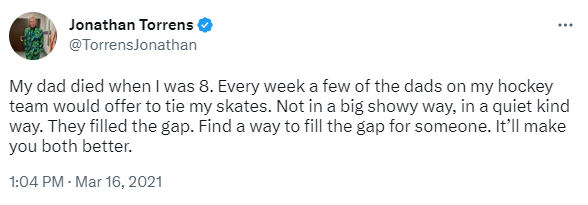
Now, I have not experienced the loss of an immediate parent. In fact, I can count on one hand the amount of times my father ever raised his voice at me and when I did not know where he was or could not immediately reach him. I’ve called my dad almost daily since I turned 12. For me to say that I don’t completely understand where the author of this tweet is coming from would be an understatement. However, I have witnessed in my own life various instances of ‘filling the gap’ as he puts it, and I would like to expound on those experiences.
The first is this: when my family moved to Jacksonville in 2003, we immediately became ingratiated with the ward our house at 12018 Michaelson was in the boundaries for – the Mandarin 1st Ward. I met many people over the years and had many formative experiences with the men, women, and other members of that congregation. One of those families I am still very close with – the Reading family. Wayne and Michelle were like second parents to me, in addition to being parents to their 5 boys. One of my very first times going to the Reading household with my dad, I saw Wayne’s car, which, to put it kindly, was literally held together with duct tape. I sort of scoffed and said, ‘Geez, why does he drive that?’ to which my dad simply replied, ‘That’s the kind of man Wayne is – he’d rather go without so that his family can have more.’
I met up with Wayne’s oldest son, Brady, while I was visiting Colorado Springs for an Ultimate Frisbee conference 2 years ago. As we were eating dinner in a restaurant in the mountains, Brady was telling me how the whole family got together to visit Utah and meet the second-oldest Devin’s new baby boy. They went out to dinner, and Brady stole away from the table to tell the waitress that he would cover the meal and to put it all on his tab. The waitress simply laughed and said, ‘Oh, your dad took me aside 20 minutes ago and told me the same thing and that you would try and pay for the meal and to not let you.’
I started cackling and said, ‘that is Wayne Reading to a tee.’ And it’s true – in the almost 20 years I’ve known the man, that is how he lives his life.
Now, you may ask, how does that have anything to do with ‘filling the gap’? Well, perhaps consider this – I had lots of positive examples from my own father, but from the other male role models in my life, many of them broadened my perspectives or opened my eyes to things I would not normally consider. Wayne taught me through his actions the virtue of selflessness and thinking of others.
* * *
Aaron Hamilton was a counselor in the Young Men’s Presidency when I was a deacon. The Hamilton family moved in right around 2007, which, coincidentally, is when the economy started to fall apart. Aaron lost his job but made a living doing handyman work and other odd jobs that he could find. I distinctly remember after one ward party, I was going around making sure there wasn’t any trash or perishable food left in rooms and I came across Brother Hamilton. Everyone left was doing something – putting up tables and chairs, vacuuming, emptying trash, etc. While those larger chores were being done, Aaron was quietly walking around the hallways and picking up any small pieces of trash that were missed by the large vacuum.
This image has been burned in my mind, and taught me two things: one, the place where we worship on a weekly basis is a sacred, holy place and should be treated as such; and two, nothing goes unseen by our Heavenly Father.
While Aaron never did find work as a helicopter pilot here in Jacksonville, he and his family left an indelible mark on me as a young man and priesthood holder trying to figure things out.
* * *
My dad was called as the bishop of the Mandarin 1st Ward 2 days before my 12th birthday. One of the things he did as the bishop was assign the young men to collect fast offerings. The young men were assigned an adult, often their father, and would go out on a route collecting fast offerings from the members.
Since my dad was the bishop and had meetings after church, Ken Lovell offered to take me and my brother on our fast offering routes. At the time, my brother was 16 and had his learner’s permit but didn’t really like driving. Ken, in his disarming way, casually flipped the keys to Jake and said, “you’re driving” and I hopped in the back. Despite Jake almost plowing into Iris Skinner’s mailbox with Ken’s nice BMW SUV, things went pretty great. Ken was an excellent model of someone I wanted to be – cool, easy to talk to, faithful in his callings, and an honorable priesthood holder.
As part of these fast offering routes, I was introduced to Dennis Myers. Denny was inactive at the time, and I, somewhat scared, walked up to his front door and rang the bell, and when his stepdaughter opened the door, I asked for Brother Myers. He came to the door and paid a fast offering, despite not having been to church in years.
Eventually, through the efforts and prayers of many, Denny came back to church and became a good friend. He helped me to fix some of the missing door handles on my 95 Camry, and when we did this, he got a little hot under the collar when he saw my scriptures for seminary sitting on the floorboard of the passenger seat. He looked at me and, with maybe a couple curse words, said, “you don’t treat your scriptures like that. They should be up in the center console if you’re gonna keep ‘em in your car.”
I don’t leave my scriptures in my car any more.
* * *
All of these men taught me what it really means to be a holder of God’s priesthood – the power of God is not for us to brag about to our friends, or to use for our own gain. No, it is for the blessing of the lives of others. All of the men I mentioned, in their own ways, taught me what it is to be an honorable bearer of the priesthood. None of these lessons were taught in a Sunday School lesson – often it was in the back of a car, or in a garage or at a kitchen table, or in the quiet, small moments after an activity was wrapping up.
I haven’t lost a parent, nor have I had to deal with difficult circumstances growing up. In fact, I probably had the opposite experience because of the grief both my parents had to go through growing up. I always had food, a warm place to sleep, kindness and love, and a peaceful home. I never lacked for pretty much anything. However, the things that my parents couldn’t provide because of their experiences, worldview, or inability to be with me 24/7 were provided for by excellent people around me who were able to fill the gaps in my foundation, and were able to teach me things that I would never be able to learn by myself.
So even if it is as simple as tying a child’s skates, or volunteering as a coach on a soccer team, or staying late to pick up trash after everyone has gone, I can guarantee you that you are teaching someone a little bit more about love, patience, and compassion, and even if no one here might see your actions, you are seen by your Father in Heaven. Of this I testify, in the name of. . .


You must be logged in to post a comment.